
WP90X Recap – Repurposed PPLI Unpacked: Turning Existing Life Insurance Into a Tax-Efficient Asset
Published: October 21, 2026
Private Placement Life Insurance (PPLI) is not a new concept for most advisory teams. The challenge is often implementation. Concerns about underwriting, complexity, disruption to existing estate plans, and long-term durability can prevent otherwise strong opportunities from moving forward.
In February’s WP90X session, Ben Rainey of WealthPoint and Anthony Stanek of Investors Preferred Life explored a different approach: What if the client already owns the hardest part, the death benefit?
Repurposed, or “synthetic,” PPLI uses an existing life insurance policy as the foundation for a new tax-efficient investment structure. Rather than replacing a policy or rebuilding an estate plan, advisors can leverage coverage already in force to create a dedicated PPLI investment account while preserving the intent of the existing plan.
Four Principles Behind Repurposed PPLI
The strategy is built around four key ideas:
- Most policy types may qualify, including term, whole life, universal life, indexed universal life (IUL), variable universal life (VUL), and survivorship policies.
- No new medical underwriting is required when an existing in-force policy supports the structure.
- The original death benefit and planning objectives remain intact.
- Existing trust ownership and estate planning structures generally remain unchanged.
When those fundamentals are understood, the strategy becomes far more approachable.
A Tax-Efficient Enhancement to an Existing Plan
At its core, repurposed PPLI uses an existing death benefit to support a new PPLI policy that includes a dedicated investment account.
The investments themselves often remain unchanged – a location change, not an allocation change. What changes is where those assets grow. Instead of accumulating within a taxable environment, assets compound inside a tax-efficient insurance chassis, allowing for tax-deferred growth and potentially tax-advantaged distributions during life, with income-tax-free death benefits to beneficiaries.
How Repurposed PPLI Works
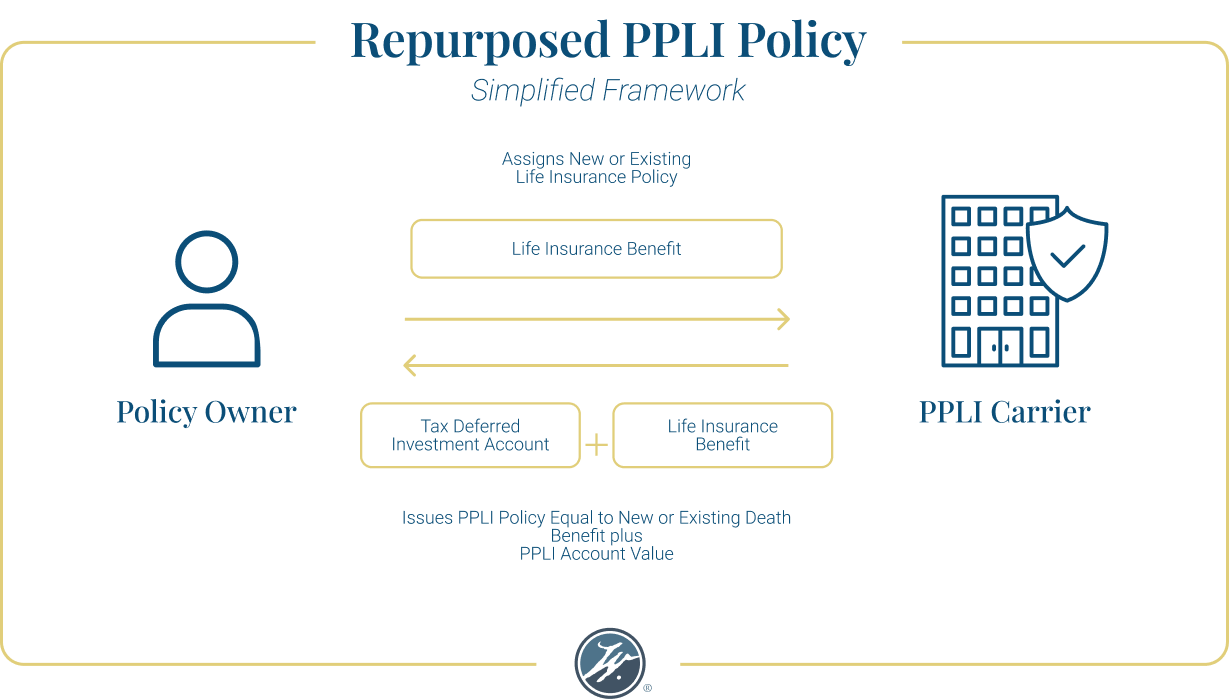
Existing life insurance serves as the foundation for a new private placement life insurance structure, allowing advisors to enhance tax efficiency without disrupting estate planning objectives.
Screening for Opportunity
One of the most practical takeaways from the session was a simple screening framework.
Rather than focusing solely on policy size, advisors should evaluate the policy’s premium capacity. As a rough guideline, premium capacity often approximates the insured’s age as a percentage of the death benefit, providing a quick way to determine whether a deeper analysis may be worthwhile.
This allows advisors to identify opportunities efficiently before investing significant time in modeling and design.
Evaluating Costs in Context
The discussion around costs focused on an important distinction. Existing insurance expenses are typically already embedded within the client’s plan. The more meaningful comparison is between ongoing policy costs and the annual tax drag created by a taxable portfolio.
In many cases, policy-level expenses can be significantly lower than the taxes paid on investment gains over time. As with traditional PPLI planning, the question is not whether the structure has costs, but whether those costs are materially less than the taxes that will be incurred.
The Potential Impact
The case study presented illustrated how meaningful the difference can be.
A trust holding both a survivorship policy and a sizeable taxable investment portfolio was modeled using a repurposed PPLI structure. Without changing the underlying investment allocation, the projected value ultimately transferred to heirs increased substantially due to improved tax efficiency.
The investments did not perform differently. The tax treatment did.
Where the Strategy Fits
Repurposed PPLI often resonates when:
- A trust already owns meaningful life insurance.
- Taxable investments are held alongside the policy.
- The client prefers to avoid new underwriting.
- An ILIT or estate plan review is already underway.
Ongoing tax drag is creating a meaningful reduction in long-term wealth transfer outcomes.
For many advisory teams, this is not a replacement strategy. It is an enhancement opportunity discovered during routine policy and trust reviews.
A Disciplined Starting Point
Before any modeling begins, advisors should focus on:
- Policy review
- Carrier strength evaluation
- Ownership and beneficiary alignment
- Realistic return and tax assumptions
When these elements are properly evaluated, repurposed PPLI can serve as a powerful tool for improving after-tax wealth accumulation within an existing estate plan.
Closing Perspective
Many affluent families have already secured the most difficult component of the planning process: the death benefit itself. Repurposed PPLI offers an opportunity to enhance that foundation by improving tax efficiency while preserving the purpose of the existing plan.
The opportunity is not about replacing what is already working. It is about determining whether an existing death benefit can support more efficient long-term compounding asset growth without
sacrificing the objectives the plan was designed to achieve. For the right client, the answer may be yes.



