
Repurposed PPLI Unpacked: Turning Existing Life Insurance Into a Tax-Efficient Asset
Published: March 11, 2026
Private Placement Life Insurance (PPLI) has long been recognized as a powerful planning tool for affluent families. However, implementation often creates challenges. Lengthy underwriting, perceived complexity, integration with existing estate plans, and administrative hurdles can prevent otherwise strong opportunities from moving forward.
During WealthPoint’s February WP90X webinar, Ben Rainey, Partner at WealthPoint, and Anthony Stanek, Managing Director at J.P. Morgan, explored a practical alternative: Repurposed PPLI, also known as Synthetic PPLI.
The central concept is simple. Many clients already own the most difficult component of a PPLI strategy: the death benefit by way of traditional life insurance. Rather than starting from scratch, advisors can evaluate whether an existing life insurance policy can be leveraged to support a new tax-efficient investment structure while preserving the client’s current planning objectives.
A More Efficient Path to PPLI
One of the most compelling aspects of repurposed PPLI is the ability to streamline implementation. By utilizing an existing policy, clients can often avoid the time, uncertainty, and disruption associated with traditional underwriting.
In many cases, the strategy allows:
- Preservation of existing death benefit protection
- Avoidance of new medical underwriting requirements
- Current trust ownership structures
- Broader estate planning objectives to stay intact
- Introduction of a tax-efficient investment component alongside the existing policy
For clients who already have life insurance in force, this can provide a significantly more efficient pathway to the benefits of PPLI.
Evaluating Existing Coverage
A common misconception is that repurposed PPLI only works with a limited range of policies. In reality, many policy types may be considered, including term insurance, whole life, universal life (UL), indexed universal life (IUL), variable universal life (VUL), and survivorship policies.
Before moving forward, advisors should evaluate three key areas:
- Policy health: Is the policy expected to remain viable under reasonable assumptions?
- Carrier strength: Is the issuing carrier financially sound?
- Plan durability: Will the structure continue to support the client’s long-term objectives?
When those elements align, an existing policy may become the foundation for a more tax-efficient planning structure.
How Repurposed PPLI Works
At its core, repurposed PPLI uses an existing death benefit to support the issuance of a new PPLI policy that includes a dedicated investment account.
The underlying investment strategy may remain largely unchanged. What changes is the environment in which those assets grow.
Assets held within a properly structured PPLI policy may benefit from:
- Tax-deferred growth
- Potentially tax-advantaged access during life, subject to policy design and applicable regulations
- Income-tax-free death benefits payable to beneficiaries
As Ben Rainey noted during the session:
“This is a location change, not an allocation change.”
The focus is not necessarily on generating different investment results. Instead, it is on improving long-term outcomes through more efficient tax treatment.
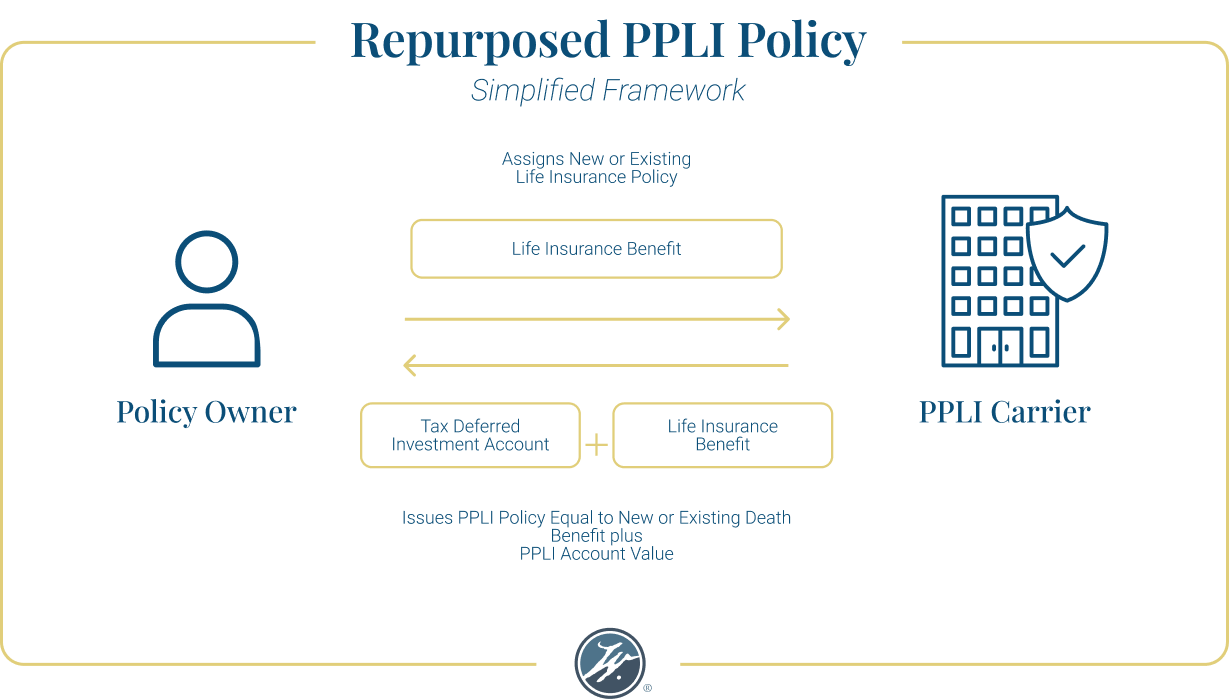
An existing life insurance policy can support a new PPLI structure that enhances tax efficiency while preserving the intent of the existing estate plan.
Identifying Potential Opportunities
Rather than focusing solely on policy size, advisors should evaluate a policy’s premium capacity. As a general rule of thumb, premium capacity often approximates the insured’s age as a percentage of the death benefit, though survivorship policies may support different ranges.
This serves as an initial screening tool, allowing advisors to quickly determine whether a more detailed analysis may be worthwhile.
Repurposed PPLI is often most relevant when:
- A trust already owns meaningful life insurance coverage
- Taxable investment assets exist alongside the policy
- The client prefers to avoid new underwriting
- An ILIT or estate plan review is underway
- Ongoing tax drag is impacting long-term wealth transfer goals
Evaluating Cost Through the Right Lens
Rather than comparing policy expenses to a hypothetical no-cost alternative, advisors should compare those expenses to the annual tax burden currently imposed on taxable investments.
The key question becomes:
Are the costs associated with the structure materially lower than the taxes currently being paid year after year?
For many affluent families, especially those with substantial taxable portfolios, the answer may be yes.
The Potential Long-Term Impact
A case study reviewed during the session illustrated how repurposed PPLI can improve long-term wealth transfer outcomes without changing the underlying investment strategy.
In the example presented, a trust owned both a survivorship policy and a sizeable taxable investment portfolio. By repositioning assets within a tax-efficient insurance chassis, projected wealth transferred to beneficiaries increased meaningfully over time.
The investments themselves did not change. The tax treatment did.
Closing Perspective
Many affluent families have already secured the hardest part of the planning process: the death benefit. Repurposed PPLI offers an opportunity to build upon that foundation by introducing greater tax efficiency while preserving the purpose and intent of the existing plan.
For advisors conducting trust reviews, estate planning discussions, or insurance evaluations, repurposed PPLI may represent a valuable enhancement opportunity. Rather than replacing what is already working, it seeks to determine whether an existing policy can support more efficient long-term compounding and improved wealth transfer outcomes for future generations.



