WP90X Recap – Family, Government and Charity: Your Allocation Decision
Published: September 18, 2025
Estate planning for ultra-high net worth families is not solely a technical exercise, but rather an allocation decision.
That was the central idea in this WP90X session from WealthPoint Managing Partner Ryan Barradas and President Michael Kenneth. The case study presented focused on a business-owning family working through a familiar but difficult set of questions: How much do we need for our own security? How much should be left to children and grandchildren? How much should go to charity? And how much, absent planning, will wind up with the government?
The solution did not begin with trust creation or investments in insurance. It began with discovery and financial modeling. Before designing anything, the planning team had to establish what the family actually wanted, what they actually needed, and what the numbers said would happen if they did nothing. From there, the family implemented an ESOP transaction alongside a simplified estate structure built around four core components: a revocable trust, a spousal lifetime access trust, a descendant’s trust, and a family foundation. The result was a zero-estate-tax outcome, GST-exempt family legacy assets, and a significant increase in the amount directed to family and philanthropy.
The Starting Point
The family owns a civil construction company. When WealthPoint first met them, the business was generating roughly $60 million in revenue annually. By the time of the presentation, that number had grown closer to $100–110 million. The married couple owned 70% of the company directly and had already transferred 30% into irrevocable trusts for the benefit of their three sons, who are active in the business. Their three daughters are not involved in business operations.
Like many entrepreneurial families, they juggle multiple objectives at once. They desire liquidity from the business they have built and want to reward the sons who have worked in the company. They want fairness across the larger family and would like to leave a meaningful charitable impact. And they want to avoid creating a structure so complicated that it dominates the next chapter of their lives.
Just beneath these objectives is an equally important concern: how to not over-enrich the next generation. They want their children and grandchildren to benefit from family wealth, but not in a way that creates dependency or lack of initiative. That tension—between generosity and restraint—became a central planning focus.
Establishing Financial Security First
Before the planning team can make any recommendations, they must first answer a more basic question: how much is enough for the couple themselves?
That answer requires more work than many families expect. Through discovery and financial modeling, the team determined that the couple needed $100,000 per month in after-tax income, growing at 3% annually. On a net present value basis, that translated into roughly $38.5 million in income-producing assets to support their lifestyle over time. A separate spousal-security analysis showed that if Tom died first, Jessica would need approximately $30.8 million in income-producing assets to remain secure on her own.
That exercise created the most important baseline in the plan. Everything above it was excess wealth.
Once that baseline is established, the planning question becomes much clearer. Excess wealth can support a larger lifestyle. It can go to children and grandchildren. It can go to charity. Or, if they fail to plan intentionally, a meaningful share of it goes to the IRS through estate tax. Barradas frames that reality bluntly: in the absence of planning, the government effectively participates in the upside of excess wealth.
Deep Discovery: What Did They Actually Want?
With the baseline in place, the conversation shifted from economics to intent.
One of the more useful takeaways from the session was that clients rarely arrive with fully formed answers. Those answers often emerge only through repeated questioning, reframing, and confirmation. Barradas described the process as asking a question, pivoting, and continuing to ask until the clients move beyond surface-level instincts and articulate the real objective.
Initially, the family had been thinking in larger numbers for the children. Through the discovery process, they landed on a target of $10 million per child in 2025 dollars, indexed for inflation. Just as important, that amount is intended to be separate from the earlier business interests already transferred to the sons, which the parents view as sweat equity tied to work performed inside the company.
The same process leads to a separate goal for the grandchildren. The couple has 18 grandchildren and expects the family to grow to 20. They want $2.5 million allocated to each grandchild, again measured in 2025 dollars and adjusted over time. Their reasoning is practical. If the children do not receive the lion’s share of their inheritance until later in life, then grandchildren might otherwise miss the window when capital is most useful for things like a first home, education, or an entrepreneurial venture.
This is not just a tax exercise. It is a family-governance exercise. It requires clarity around what is fair, what is enough, and what role wealth should play across generations. WealthPoint brings the broader advisory team into the process so that every major decision can be measured against the same set of goals.
The ESOP Transaction
The family also needed a transition plan for the business itself.
As the presenters explained, when Tom considered who he wanted to sell the company to, he kept returning to the same answer: the people he worked with every day. That led to an ESOP transaction. The business sold for approximately $160 million, financed in part with a $61 million bank loan and in part with seller carryback debt. Because the seller debt was subordinated to the bank debt, the family would receive interest-only payments while the senior debt remained outstanding, followed later by principal and interest once the bank debt was repaid or refinanced.
The transaction also included warrants representing 17% of the company and an earnout tied to future growth. The warrants provide future upside if the company’s value continues to appreciate, while the earnout reflects the company’s strong backlog and momentum during the transaction period.
This matters because the ESOP is not merely a business-succession event. It creates the asset mix that makes the estate plan possible: current liquidity, a seller note with predictable cash flow, and future appreciation potential through warrants. Those pieces became the raw material for the family’s broader planning strategy.
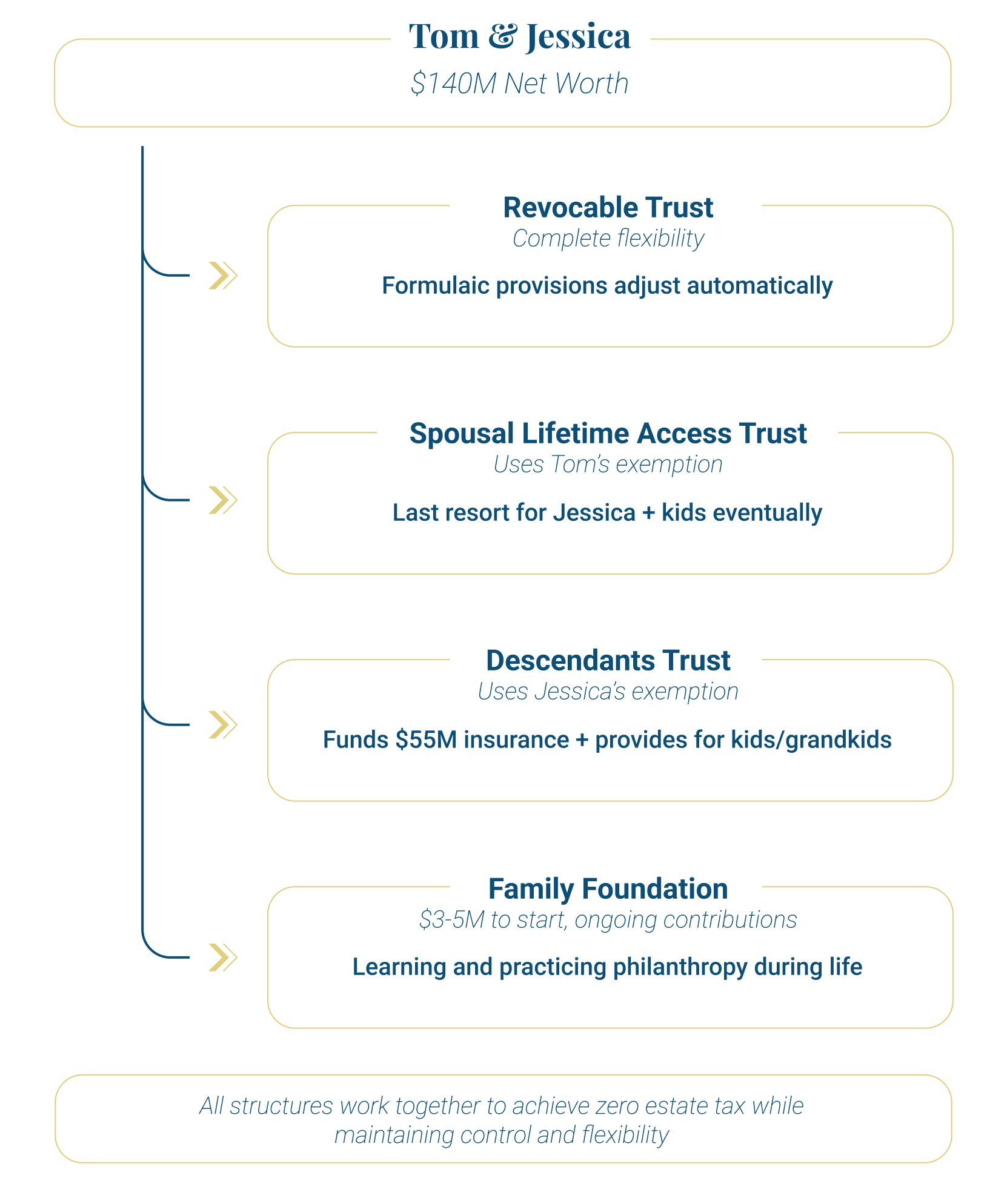
The Estate Plan
The family does not want an endlessly layered plan. They want something that solves the major problems while preserving flexibility and time.
The first component is the revocable trust, which serves as the family’s main flexibility mechanism. It can adapt if the couple later changes their minds about how much to allocate to different children. It also uses formulaic provisions directing the trustee to first consider assets already outside the estate. If those outside assets are sufficient to satisfy the family’s target inheritance amounts, the remainder flows to the family foundation.
The second component is a Spousal Lifetime Access Trust (SLAT) funded by Tom after converting certain community property to separate property. The planning team focuses on the warrants and part of the ESOP note because of their appreciation potential. Jessica has a beneficial interest in the trust, but the structure is designed as a last-resort source of access rather than a primary lifestyle asset. It sits outside the taxable estate and remains GST exempt.
The third component is a descendant’s trust funded using Jessica’s remaining exemption. This trust is designed for children and grandchildren and is also GST exempt. It receives primarily the seller note, which the team believes can support a valuation discount because of its subordinated nature. A portion of the note’s cash flow funds a survivorship life insurance policy of roughly $54–55 million. That insurance creates liquidity precisely when the plan needs it—upon the second death.
The fourth component is the family foundation. The family plans to begin funding it during life, starting with roughly $3–5 million and continuing with additional contributions over time. The presenters emphasize that creating the foundation during lifetime matters because philanthropy only becomes a durable family practice if the family learns to do it together while both generations are still alive.
Why the Insurance Mattered
The insurance in this plan was not presented as a standalone product. It was part of the balance sheet design.
If both spouses died, the death benefit is paid to the descendant’s trust, which could then use the cash to buy illiquid assets out of the estate. That matters because some of the family’s remaining assets—commercial real estate and the equipment leasing company, for example—were not ideal charitable assets and needed continuity. The insurance creates the liquidity needed to preserve those interests while allowing the estate plan to distribute liquid assets where appropriate.
The amount of coverage chosen was not arbitrary. It was derived through modeling based on what the family would need to satisfy the inheritance targets over time. The note’s cash flow was expected to support the carrying costs, allowing the trust to remain economically functional while also building long-term value for descendants.
The Results
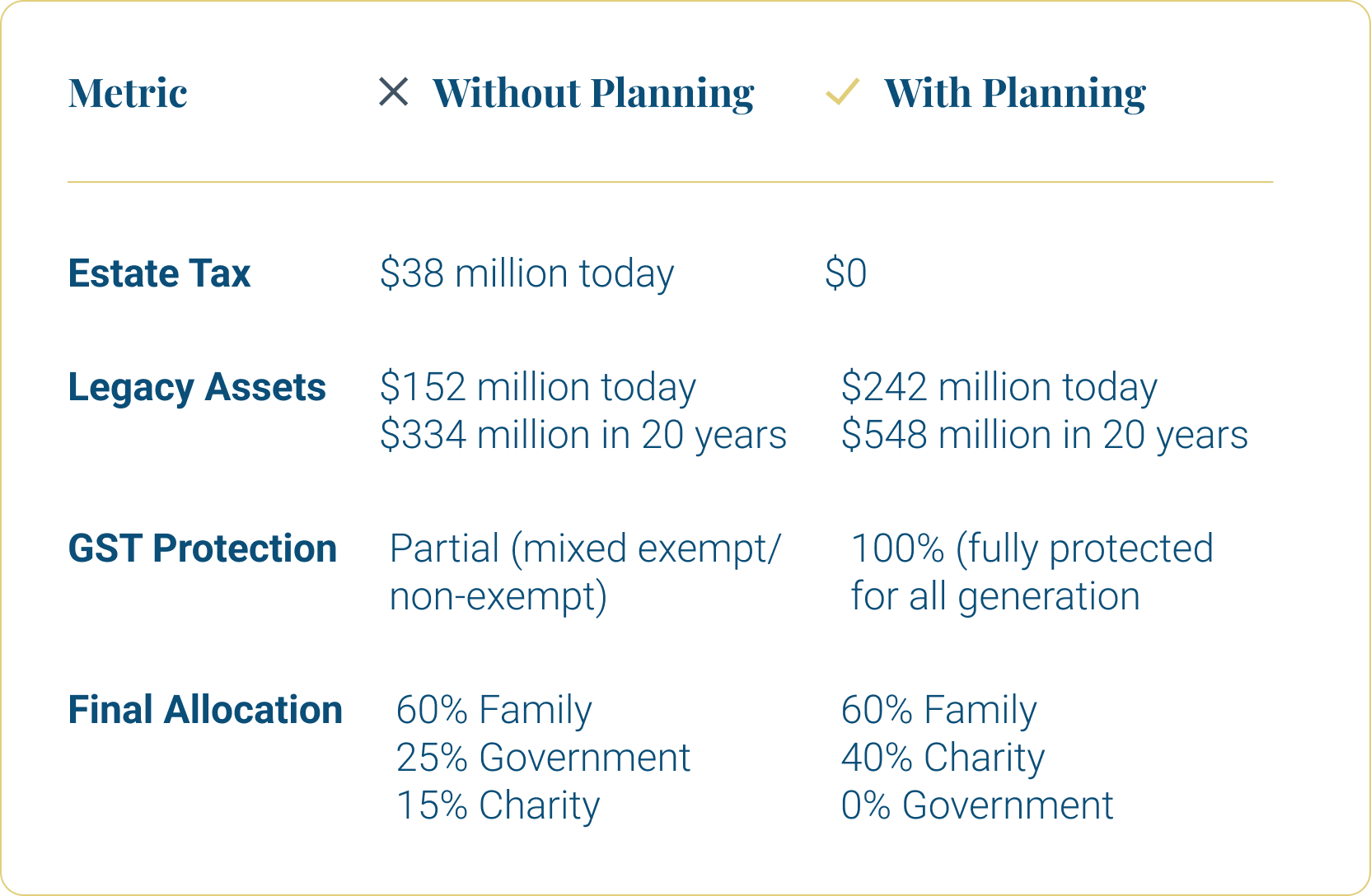
The clearest result was simple: estate tax went from roughly $38 million to zero under the proposed plan.
But the broader result was more important.
Under the family’s prior structure, total legacy assets—meaning assets ultimately going either to family or charity—were approximately $152 million. Under the new plan, that figure increased to roughly $242 million in the current analysis. Over a 20-year projection, legacy assets increased from about $334 million under the old structure to roughly $548 million under the new one. In practical terms, the redesign added about $90 million of current legacy value and more than $200 million of projected long-term value.
The quality of the assets changes as well. All assets going to family become GST exempt. The allocation also becomes more intentional. Children and grandchildren are expected to reach the family’s target levels over time, but not immediately, which aligns with the goal of avoiding over-enrichment during the parents’ lifetime. At the same time, the charitable component becomes substantial rather than residual.
Even after the plan was implemented, the family still maintained strong cash flow. The revocable trust assets were projected to generate approximately $2.4 million in net positive annual cash flow, excluding the SLAT cash flows still accessible to Jessica. In other words, the strategy improved transfer outcomes without compromising lifestyle flexibility.
What Made This Work
Three things stand out.
First, the team established the family’s financial-security line before debating structures. They identified what the couple needed and treated everything above that level as intentional allocation capital.
Second, the discovery process changes the outcome. It clarifies what is enough for children, creates a separate objective for grandchildren, and aligns the planning team around a shared definition of success.
Third, modeling gave the family confidence to act. It lets them test different outcomes, stress assumptions, and see the ripple effects of each decision across beneficiaries, tax categories, and time horizons. That visibility is what turned an abstract strategy into an implementable one.
This was not just a story about reducing estate tax. It was a story about clarity. Once the family defined what was enough, determined what they wanted their wealth to do, and saw the economic consequences of each path, the planning became far more straightforward. The emotional questions did not disappear. But they became answerable because the family could finally weigh them against long-term reality.