PPLI for Family Offices: A Smarter Structure for Long-Term Wealth
Published: February 26, 2026
Ultra-affluent families don’t plan around quarterly returns or market cycles—they plan in decades, across multiple generations.
When we sit down with families and their advisors, the conversation quickly moves beyond whether a portfolio can perform. The real question is durability. Over long horizons, wealth is shaped less by short-term volatility or manager selection and more by tax drag, the quiet compounding erosion that pulls capital out of a strategy year after year. Even strong, well-constructed portfolios can see meaningful value slip away as ongoing taxes steadily reduce what remains invested.
Private Placement Life Insurance (PPLI) offers a solution. By combining life insurance with investment flexibility, a PPLI policy provides a structure designed to protect and grow wealth across multiple generations.
We’ll explore how PPLI works from the first generation through the second, to the third generation (G1 to G2 to G3), showing how thoughtful planning today can preserve and expand wealth far into the future.
What is PPLI?
PPLI is a life insurance structure designed for affluent investors. It allows a portfolio to grow inside a tax-advantaged policy, which:
- Maintains investment flexibility.
- Minimizes tax drag.
- Delivers tax-free benefits to heirs.
For a deeper dive, see our full PPLI Summary.
How PPLI Transforms Generational Wealth
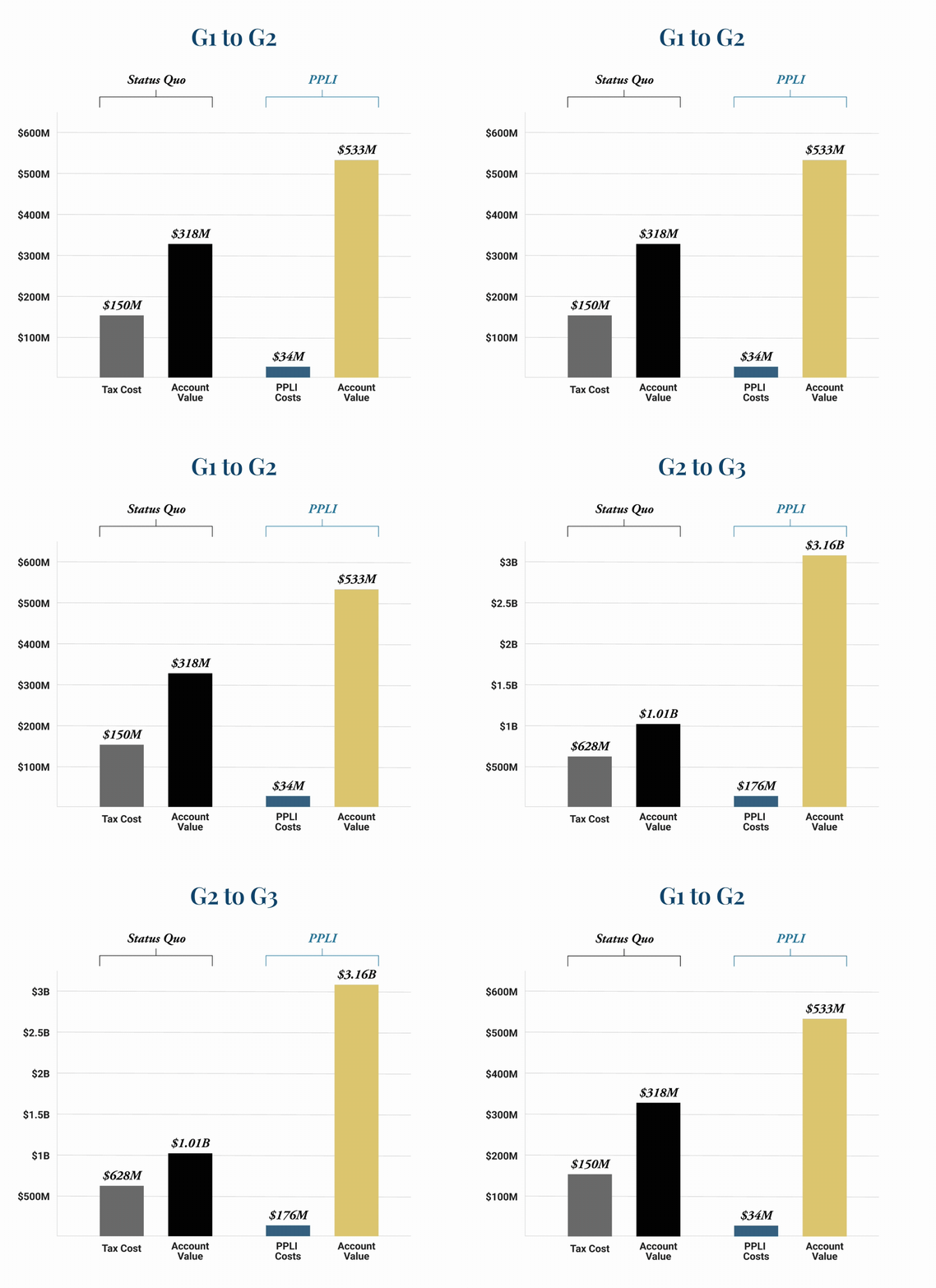
Family offices don’t make long-term decisions on intuition alone. They rely on modeling—pressure-testing outcomes across generations to understand what truly compounds and what quietly erodes. To illustrate this impact, consider a $100 million family office allocation modeled across three generations.
In both cases, capital follows the same investment strategy and earns an 8.0% annual return. One structure holds assets in a taxable account, subject to a 40.80% effective annual tax drag. The other places assets inside PPLI, including standard policy costs. At each generational transition, death benefit proceeds fund new PPLI coverage, allowing capital to remain invested rather than reduced by ongoing taxation.
G1: Immediate Impact
- Status quo portfolio: $318M
- With PPLI: $533M
- Income taxes avoided: $150M
G1 + G2: Multigenerational Protection
- Income taxes avoided across generations: $628M
G3: Long-Term Payoff
- Without PPLI: $1.01B
- With PPLI: $3.16B
- Additional family capital assets created: $2.1B
Both scenarios use the same investment strategy. The difference is purely in the tax structure. Family offices routinely use this modeling to evaluate long-term decisions. PPLI doesn’t change the investments themselves—it changes the way compounding works, unlocking significantly larger multigenerational outcomes.
The Compounding Effect: $100M Over Three Generations
What PPLI Protects Against
In practice, taxes—not market volatility—are the largest long-term drag on wealth. PPLI removes this friction, allowing investments to grow uninterrupted.
Over decades, the difference becomes increasingly clear. Taxable structures steadily lose value to ongoing taxation, while PPLI-based portfolios will compound at a meaningfully faster rate.
The underlying principle is straightforward. When the long-term cost of insurance is lower than the taxes a portfolio would otherwise pay, PPLI creates a structural advantage that lasts a literal lifetime. Family offices tend to recognize this early, which is why PPLI planning often begins with G1. Starting at the first generation allows families to set the foundation for more durable wealth preservation in G2, G3, and beyond.
How Family Offices Use PPLI
PPLI integrates seamlessly into existing structures, making it a preferred tool for sophisticated families:
- Integrates with all existing irrevocable trust structures, no matter how many or how complex
- Keep current advisors to avoid disruption to trusted relationships.
- Maintain existing investment strategies so that the portfolio itself doesn’t change.
- Use familiar custodians so that operations continue smoothly.
- Access broad investment options like private equity, hedge funds, venture capital, private credit, and more
The key point: PPLI does not require changing what the family invests in. The only change is adding the tax-efficient wrapper holding the assets. This simplicity allows families and their advisory teams to unlock multigenerational wealth preservation without overhauling existing processes.
Why PPLI Magnifies Multi-Generational Planning
Family offices succeed by managing long-horizon tax drag, not chasing performance. PPLI aligns directly with that strategy:
- Tax-free growth and death benefits—structural leverage across generations
- Protection from future tax policy shifts—contractual guarantees plus statutory security
- Flexibility and control—long-term strategies remain intact.
- Reduced forced liquidity risk—especially during generational transitions.
By G2 and G3, these advantages shift from incremental to transformational. Families can retain more wealth, transfer more to heirs, and avoid the erosion taxes and forced liquidity often create.
PPLI is not just a product—it’s a stable, tax-efficient compounding engine, designed for decades of results and seamlessly woven into a family’s long-term strategy.
Is PPLI the Right Fit?
PPLI is best suited for ultra-high-net-worth families and family offices managing complex, multi-generational wealth. It appeals to those seeking income-tax efficiency, estate planning advantages, and continued investment control, while maintaining solutions that support long-term planning without disrupting existing strategies or advisor relationships.
When used thoughtfully, PPLI helps families keep more of what they’ve built—across generations. WealthPoint can model your specific G1 → G2 → G3 impact and determine whether PPLI is suitable, efficient, and designed correctly for your family’s strategy. Contact us to explore whether PPLI belongs in your plan.